
Most of the work in a house with young children is not one enormous task. It is the same small task returning all day.
Pour another drink. Open another snack. Peel another orange. Find the shoes. Decide whether the snack is allowed. Locate the backpack. Clean up the milk. Find clean underwear. Throw away the wrapper someone carried into the living room.
None of those jobs is especially difficult. The exhausting part is being the only bridge between every child and every ordinary need.
Read the full story behind the setup
I did not want a house that looked like a Montessori catalog. I wanted a house my actual children could operate.
That distinction matters because I have made attractive, reasonable systems that my children simply did not use. I once made a water station for them. They chose the sink sprayer instead. My seven-year-old can reach it. My five-year-old moves something over so he can reach it too. They also pour their own milk or juice and wipe up ordinary spills.
The useful lesson was not that I needed to enforce my better-looking water station. It was that they had already shown me the movement they were willing to make: go to the sink, get the drink, and clean up if needed.
Do not begin by buying an independence system. Begin by watching the system your child is already trying to create.
I teach skills deliberately as each child shows interest and ability. My oldest has always chased independence. My younger child still prefers help with many things, but he enjoys cooking, so I transfer responsibility as he can tolerate it. The handoff does not have to happen at the same age or in the same order for every child.
The aim is not to make children need their mother less. It is to let them participate in family life as real members of the family. I still decide what enters the house, teach the skill, supervise risk, replenish supplies, and step in when a job exceeds the child’s judgment. They do the part that is genuinely within reach.
01How I decide what they can handle
Every useful home system has three parts:
| Mom sets up and maintains | The child handles | An adult still handles |
|---|---|---|
| Chooses what is safe, acceptable, reachable, and worth keeping in rotation | Chooses, carries, opens, pours, dresses, returns, throws away, or wipes | Heat, broken glass, chemicals, food-safety judgment, major spills, and anything beyond demonstrated ability |
| Teaches one new step at a time | Repeats the familiar sequence | Changes the system when a baby, new skill, or new hazard changes the house |
| Restocks during work already happening | Completes the ordinary reset | Notices hidden mess, expired food, damage, and situations that require adult judgment |
That is the standard I use for every product in this guide. I am not interested in an organizer that merely moves work around. A product earns its space when it removes a repeated decision, a repeated search, or a repeated job from me.
02How they get their own drinks
When my children were smaller, they could tell me or indicate what they wanted to drink. I filled a cup with milk or water and left it on the table so they could return to it. When the cup was empty, they put it in the sink.
That was the preschool handoff:
- The child communicates the need.
- The adult handles the heavy container and the pour.
- The child carries the cup, drinks, and returns it to the sink.
Now they can do more. They use the sink, pour some drinks, and clean an ordinary spill. They use real glasses, plastic cups, water bottles, and, most often, Mason jars. (paid Amazon links)
We own the spill-proof cups with all the special pieces. I do not prefer them. They are harder to clean, and the cup system itself becomes another job. Our Mason jars (paid Amazon link) are simple, easy to see inside, and have held up surprisingly well on our wood floors. That does not make glass unbreakable. A family with tile floors, a child who throws cups, or a younger child who cannot carry glass safely should choose something else.
A silicone sleeve for a pint Mason jar (paid Amazon link) can add grip and a little cushioning. It cannot make a glass jar shatterproof.
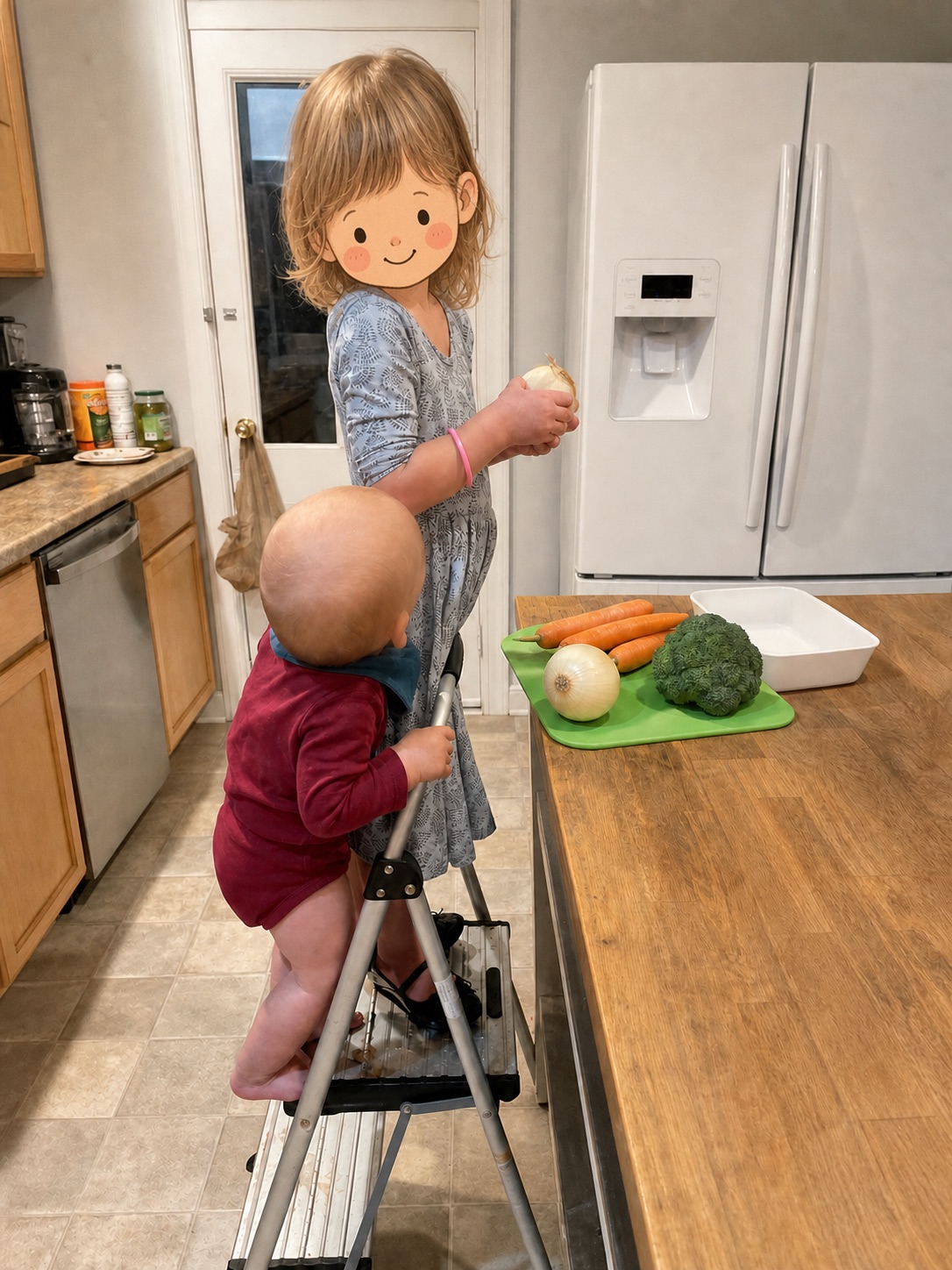
My children’s chosen sink route also showed me a weakness in the setup. A dining chair is not the permanent product I would recommend for reaching a sink. A sturdy, broad, non-slip step stool (paid Amazon link) is the cleaner version of the same idea. It should be used where an adult can supervise and moved or secured when a mobile baby turns it into climbing equipment.
What the water handoff looks like by age
Preschool: The child indicates the drink, carries a light cup, returns it to the sink, and helps wipe a small spill while an adult stays nearby.
Early elementary: The child can fill water, pour from a manageable container, choose a cup, and clean an ordinary spill. A full milk or juice container may still be too heavy.
Older child: The next handoff can include refilling a small pitcher, checking whether clean cups are available, and adding milk or juice to the grocery list. I have not reached this stage with my own children, so I would treat it as the next logical handoff, not as personal testimony.
Buy only what solves the actual problem
A water station is useful when it gives the child a route that is easier than asking an adult. It is not useful merely because it is child-sized.
Start with the current route. Does the child need height, a lighter container, an easier cup, a visible home for cups, or permission to use the sink? Buy only the missing piece.
03What I put in their snack drawers
My children do not need to ask for every snack because I have already made the decision upstream.
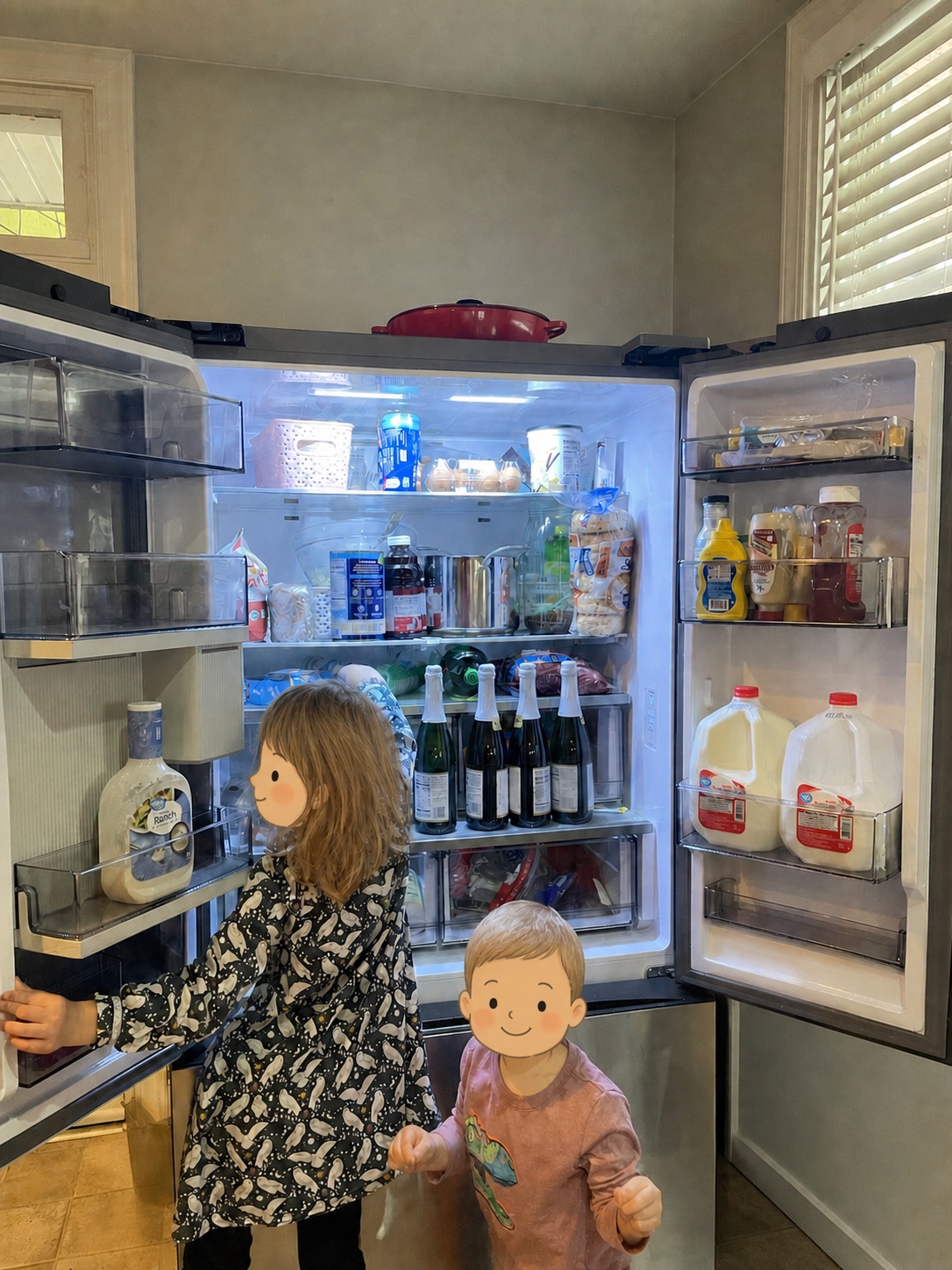
The refrigerator’s produce drawers are our kid snack drawers. I stock them with foods such as string cheese, yogurt pouches, Go-Gurt, snack-size mozzarella packs, mandarin oranges in juice, fully cooked hot dogs, and turkey or ham lunch meat.
In the pantry, graham crackers, Goldfish snack packs, That’s It fruit bars, and granola bars live where the children can reach them. (paid Amazon links) The dining table holds bowls of easy-peel mandarins, apples, and bananas.
I also keep my independent-eating and cleanup picks together on Benable. (paid-link collection)
They may choose from those foods when they are hungry.
Unlimited access does not mean every food in the house is unlimited. It means I created a defined collection of foods for which the answer is already yes.
This is our household setup, not a universal feeding prescription. A child with allergies, diabetes, swallowing concerns, food-seeking behavior, a medically prescribed diet, or another specific need may require a different boundary. The transferable principle is that the adult chooses what enters the lane and the child does not have to renegotiate the same decision all day.
When my children were younger, they could bring me a piece of fruit. I peeled it, and they threw away the peel. They learned the disposal step while I still handled the part beyond their ability. As they learned to open packages and peel easier fruit, I transferred those steps too.
They are climbers and figured out how to open the refrigerator and reach the drawers fairly early. At first, they still needed help opening most of what they retrieved. I did not interpret that as proof the snack lane had failed. It meant they had completed the first half of the job and were ready to learn the next half.
The snack lane has four rules
Everything in the lane is an actual yes. Do not fill a reachable bin with food the child must still ask permission to eat.
The child can see what is available. I do not keep much backstock. Clear and open storage (paid Amazon link) matters because I notice shortages by seeing them.
The packaging matches the child’s current skill. A preschooler may retrieve the food and bring it to an adult. An early elementary child may open familiar packages. An older child may help notice and list what needs replacing.
Food safety and choking risk do not transfer automatically. The American Academy of Pediatrics identifies hot dogs, chunks of cheese, string cheese, whole grapes, popcorn, and several other foods as choking hazards for younger children. Food should be modified for the child’s age and chewing ability. Hot dogs for younger children should be cut lengthwise and then into small pieces, not served as round coins. See HealthyChildren.org’s choking-prevention guidance.
Food is not allowed in bedrooms in our house, although that rule is a recurring battle. Independence does not mean the child chooses every boundary. It means the child can complete an approved job inside a boundary the parent has already set.
04How they choose their own clothes
Traditional clothing organization asks an adult to sort shirts, pants, underwear, pajamas, socks, and seasonal clothes into separate drawers.
My children’s real question is much simpler:
What can I put on my body right now?
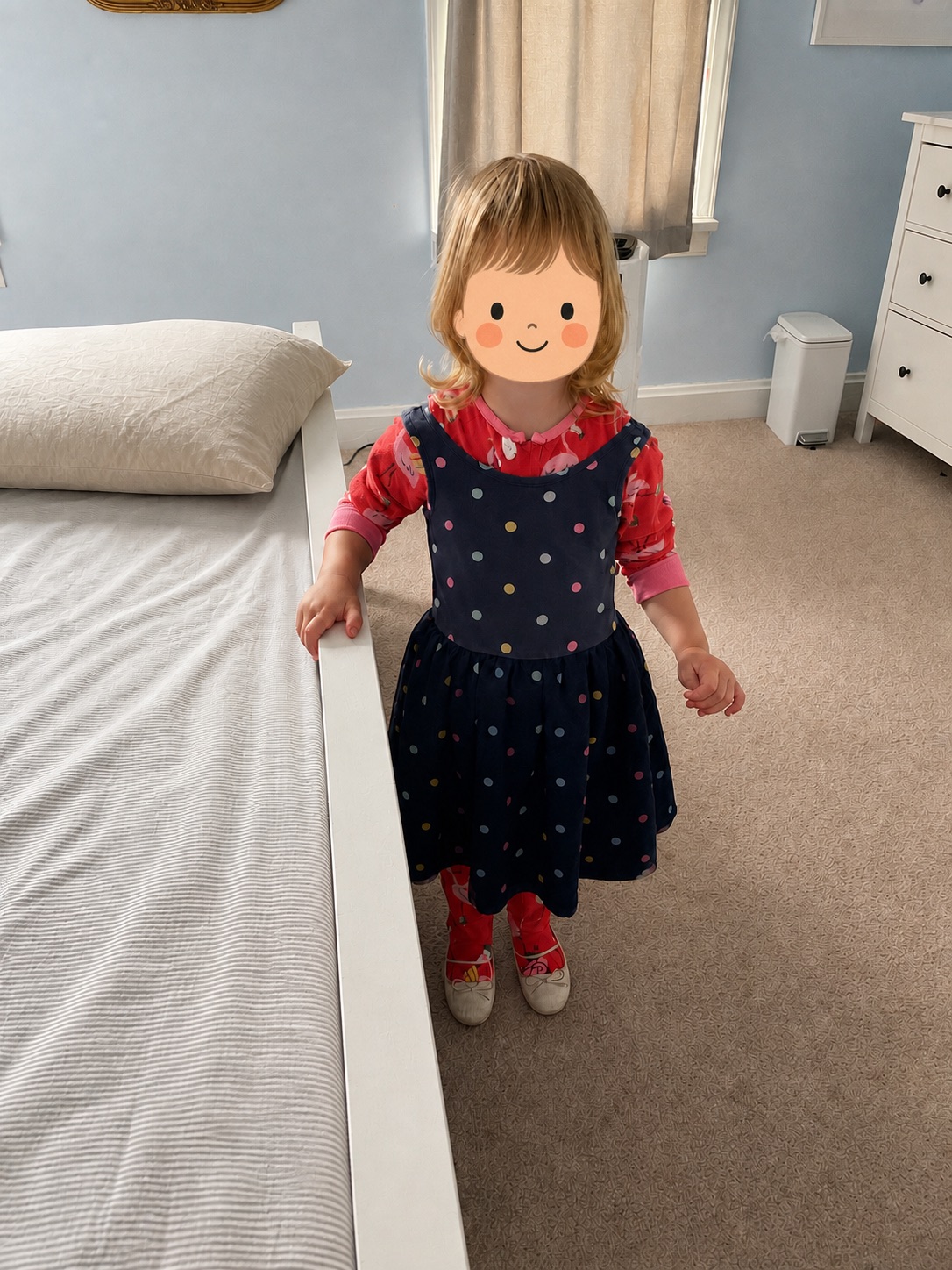
Each child has a white plastic basket (paid Amazon link). White means clean.
Dirty clothes go into a brown woven basket (paid Amazon link). Brown means dirty.
My seven-year-old has a limited range of underwear, dresses, bathing suits, and play shorts she will accept. Everything that is clean and approved goes into her white basket. I do not sort it further.
My five-year-old has shirts, bottoms, and underwear in his basket. He decides whether the bottom is shorts or pants and chooses the combination himself.
I approve what enters rotation. That is the part that prevents a basket full of clothes a child will not wear. I wash the clothes and put them into the clean basket when dry. Their part is to choose, dress themselves to the level they can manage, and put the clothes into the dirty basket afterward.
They have chosen their own clothes since they were around two. When they were little, I helped with the physical dressing step. The choice came before the full motor skill.
Why the basket system works
Every clean item is wearable. The child is not sorting through aspirational clothes, itchy clothes, wrong-size clothes, or clothes Mom wishes the child would accept.
The color carries the instruction. White is clean. Brown is dirty. The child does not need to read a label or remember which identical basket means what.
Folding is not a dependency. If folding does not improve the child’s ability to find or use the clothes, I do not make it the price of having clean clothing.
The reset is one movement. Dry clothes go into the white basket. Worn clothes go into the brown basket.
The most independent wardrobe is not the most varied wardrobe. It is the wardrobe in which every available option is a real option.
05Where shoes, bags, papers, and gear go
A landing zone fails when it contains too many decisions.
Ours is simple:
- Each child has one open plastic bin (paid Amazon link) for shoes by the door.
- Bags hang on a hook rack (paid Amazon link) by the door.
- Papers are dealt with immediately when we come in.
- Equipment either stays in the van because that is where we need it, or it goes into sturdy plastic bins in a cube-style bookshelf. (paid Amazon links)
- Seasonal gear is grouped by use. In winter, one bin holds hats and another holds mittens. In summer, one bin holds the pool supplies.
I do not create a beautiful incoming-paper system if the paper can be handled now. It gets thrown away, signed, answered, filed where the next action happens, or otherwise completed. A “paper” basket that contains five different future actions merely hides five decisions.
The shoe bins are open because lids add a step that does not help us. The hooks are near the door because a hook in a bedroom does not solve the arriving-home problem. (paid Amazon links) The seasonal bins are visible enough that the children can participate and sturdy enough to survive real use.
A cube organizer or bookcase that children can pull on or climb must be secured with furniture anchors (paid Amazon link). The U.S. Consumer Product Safety Commission advises anchoring furniture with shelves, drawers, and doors to prevent tip-over injuries. See the CPSC Anchor It guidance.
What happens when a child walks past the bin
I do not keep explaining where the shoes belong.
I pause whatever comes next.
“I’ll pause your episode of Spidey and His Amazing Friends. When your shoes are put away, let me know and I’ll turn it back on.”
The consequence is immediate, proportionate, and connected to finishing the current job. I am not taking away tomorrow’s privilege because of today’s shoes. I am preventing the next activity from beginning while the previous activity remains open.
That matters because a system is not only a bin. It is a location, a child-usable movement, and a predictable follow-through.
06What they use to clean spills
My children clean ordinary spills themselves as long as the spill is not hot and does not involve broken glass.
If a large spill runs under furniture or across details they do not notice, I help. That is an adult-judgment problem, not a moral failure in the cleanup system.
Paper towel rolls are staged around the house. Baby wipes are also available for the small messes they can handle. (paid Amazon links) My younger child enjoys spraying, so windows and certain approved surfaces can become a useful job for him.
The principle is simple:
The best cleanup tool is the one the child can find before the liquid reaches the furniture.
We also use Force of Nature cleaner (paid Amazon link), the hypochlorous-acid cleaner made in its countertop electrolyzer. U loves helping me make a fresh batch and use it on approved surfaces.
That does not mean I hand him a spray bottle and walk away. We make and use it with adult supervision. I stay present, choose the surface, make sure it is prepared and used according to the directions, and put the appliance, Activator Capsules, and spray away appropriately when we are finished. But it lets his desire to spray become actual useful work instead of something I have to fight all day.
The starter kit uses tap water and a premeasured Activator Capsule to make a 12-ounce bottle. Force of Nature says a correctly made batch keeps its cleaning and disinfecting power for two weeks. It is an EPA-registered disinfectant, and I am comfortable using it around my children when it is made and used as directed. See the manufacturer’s starter-kit information.
This is a supervised handoff, not an unsupervised child-accessible chemical station. It is also different from the homemade dish-soap-and-rubbing-alcohol spray we sometimes use. The homemade spray remains an adult-prepared product, and once our one-year-old becomes mobile enough to reach the stations, every spray bottle will have to move behind the magnetic locks again.
Poison Control reports that spray bottles are a leading source of cleaning-product exposures in children and advises storing them out of sight and reach. CPSC likewise advises keeping cleaners locked and in original child-resistant containers. See Poison Control’s spray-bottle guidance and CPSC poison-prevention guidance.
I would not publish a homemade cleaner recipe as though every transferred bottle, ingredient, surface, and age were interchangeable. If a family transfers any product, it must be clearly labeled and stored safely, and the safest general practice remains keeping household chemicals in their original containers.
The child-usable cleanup lane
Keep within reach for independent cleanup:
- Paper towels or washable cloths (paid Amazon links)
- Baby wipes (paid Amazon link)
- A small broom and dustpan (paid Amazon link)
- A squeegee (paid Amazon link) for an approved surface
- A wastebasket (paid Amazon link) the child can use safely
- Plain water when water is enough
Use only with an adult present:
- Force of Nature (paid Amazon link), made and used according to the manufacturer’s directions
- Any spray bottle, even when the finished product is appropriate for use around children
Keep adult-controlled and inaccessible:
- Homemade alcohol-containing mixtures
- Bleach, conventional disinfectants, pods, and concentrates
- Broken-glass cleanup
- Hot spills
- Large spills that travel under furniture or appliances
07How I teach kitchen and life skills
One child’s independence can look like, “I can do it myself.”
Another child’s independence can look like, “I will stir while you hold the bowl.”
Both count.
I deliberately teach skills as interest and ability appear. I do not wait for a birthday to grant a new responsibility, and I do not assume the same responsibility belongs to both children because they are close in age.
My oldest uses the microwave for a short list of approved foods. She asks before using it unless it is something she has done many times, and even then she often checks the timing with me.
Whether she handles the hot item depends on the item. She can manage a single hot dog. She does not remove the hot glass popcorn popper.
My younger child cannot safely pour from a full milk or juice container. That means the next handoff may be pouring from a lighter container, not simply telling him to try harder.
They know where the hot mitts (paid Amazon link) are and use them when there is any doubt. I still check food temperature. USDA guidance recommends reheating leftovers to 165°F and allowing standing time after microwave heating because microwaves can heat unevenly. See USDA microwave safety guidance.
A realistic age-and-stage ladder
| Job | Preschool handoff | Early elementary handoff | Older-child next handoff |
|---|---|---|---|
| Drinks | Communicate choice, carry light cup, return it | Fill water, pour manageable container, wipe spill | Refill small pitcher, check cup supply, add item to grocery list |
| Snacks | Retrieve approved item, bring it for opening, throw wrapper away | Choose from yes-zone, open familiar package, peel easy fruit | Help restock, notice shortages, prepare simple combinations |
| Clothes | Choose from two or more approved items, help dress, place clothes in dirty basket | Choose full outfit, dress, return dirty clothes | Help move dry clothes to baskets, notice low underwear or socks |
| Landing zone | Carry one item to its picture or color-coded home | Put away shoes and bag, complete a short reset | Pack gear from a checklist and help rotate seasonal bins |
| Cleanup | Wipe a small spill with adult nearby | Clean ordinary non-hot spills and sweep a small mess | Notice hidden edges, refill paper products, complete a room reset |
| Kitchen heat | Watch and help with cold preparation | Use only approved microwave tasks with adult rules | Expand the approved list as judgment and heat handling improve |
The older-child column is a planning ladder, not a claim about my personal experience parenting older children.
08What changes when the baby gets mobile
Our youngest is one. At the moment, he is not mobile enough for the older children’s stations to be a problem.
When he is, I will lock things again as I have before. I like Safety 1st magnetic locks (paid Amazon link) because the lock sits inside the cabinet and the magnetic key can be stored high.
My babyproofing starter list on Benable keeps the cabinet, outlet, and furniture-safety options in one place. (paid-link collection)
The moment a baby becomes mobile, I re-evaluate:
- Can the baby reach snack foods that are choking hazards?
- Can the baby pull down a hanging trash bag or plastic bag?
- Can the baby reach paper towels and unroll the entire house?
- Can the baby climb the step stool or chair?
- Can the baby access a spray bottle, medicine, laundry product, or alcohol-containing mixture?
- Can the baby pull on a cube organizer, bin, or hook rack?
- Are older children carrying food into rooms and leaving pieces where the baby can find them?
The answer is not necessarily to dismantle every older-child handoff. It may mean the snack lane moves higher, the older children learn a magnetic-lock routine, the cleaner becomes adult-only, and small food stays at the table.
Child access should be selective. A five- or seven-year-old can be capable of a job that remains wholly inappropriate for a one-year-old.
Locks are a layer, not a substitute for adult judgment. Store the magnetic key high, anchor furniture, and change the setup again when the baby learns to defeat the current barrier.
09How I restock and reset everything
I do not perform a nightly Pinterest reset of every station.
I grocery shop about twice a week. That is when the snack drawers and fruit bowls are replenished. I do not keep a large backstock. Because the food is visible, I notice what is running low.
My children carry groceries from the door to the kitchen and sometimes help put them away. Usually I do the actual putting away. That is our current handoff. Carrying the load is their part; inventory and placement are still mine.
Laundry is not a once-a-week event in our house. It has to be at least one load most days or the backlog becomes terrible. My children resist laundry, so I am not going to write as though they happily manage a complete laundry cycle. Their real job is choosing from the clean basket and returning worn clothes to the dirty basket. Mine is keeping the baskets supplied.
The van accumulates trash quickly. About once a week, while we are already out running errands, I stop at a large car-wash place with easy trash stations. Everyone has to shovel the trash into the cans.
That is the reset principle I trust:
Do not invent a separate reset ceremony if the system can be reset during grocery shopping, laundry, errands, or the transition to the next activity.
The real two-minute daily reset
A literal timer is optional. The useful version is closing the unfinished loops that are blocking the next part of the day.
- Shoes into each child’s bin
- Bags onto hooks
- Wrappers into the trash
- Dirty clothes into the brown basket
- Cups into the sink
- Paper towels (paid Amazon link) replaced where a roll is empty
When a child refuses, I pause the next activity until the current job is complete.
The real weekly refill
- Refill the snack drawers and fruit bowls during grocery shopping
- Wash at least enough clothing to keep the approved rotation usable
- Clear the van while already out
- Rotate the seasonal bins when the season changes
- Replace paper towels and wipes (paid Amazon links) where they are actually used
- Check whether the baby has reached a new mobility stage
- Notice which system the children are bypassing and ask why
10How to set up one system
Start with the small request that comes back most often.
Step 1: Observe for three days
Do not begin with a shopping cart. Notice where the child goes, what the child can already reach, what the child brings to you, and where the job breaks.
Step 2: Name the adult-only step
Is the child asking because the item is too high, too heavy, too difficult to open, not clearly permitted, or impossible to find?
Those are different problems. They need different products.
Step 3: Create one real yes-zone
Every reachable choice in the zone should be a choice you can accept. A bin full of conditional choices still routes the decision through you.
Step 4: Remove sorting that does not help the child
If the child only needs to know clean or dirty, use clean and dirty. If the child only needs pool gear, put the pool gear together. Organize around the next action, not around the number of categories an adult can create.
Step 5: Teach the complete loop
Getting the snack is not the full job. The full job may be getting it, opening it, eating in the approved place, throwing away the wrapper, and putting the cup in the sink.
Teach one added step at a time.
Step 6: Decide the safety line before access expands
What remains adult-only? What changes when a baby becomes mobile? What gets locked? What requires supervision?
Step 7: Attach the reset to a rhythm you already have
Grocery day, daily laundry, the end of an episode, walking in the door, and the weekly car-wash stop are all stronger than an idealized reset you have to remember from scratch.
11What I would buy first
I would not buy forty matching organizers before watching the children.
I would begin with six useful categories:
- A stable step stool (paid Amazon link) if reach is the true barrier
- Clear, open fridge and pantry bins (paid Amazon link) if permission and visibility are the barrier
- A white clean-clothes basket and a brown dirty-clothes basket (paid Amazon links) if clothing decisions are the barrier
- Low hooks and open shoe bins (paid Amazon links) if returning gear is the barrier
- Magnetic locks and furniture anchors (paid Amazon links) when a baby or climbing child changes what can remain accessible
- Force of Nature cleaner (paid Amazon link) when a child’s interest in spraying can become a real, supervised cleaning job and the system will replace cleaners you already buy
12What I would skip
Complicated spill-proof cups that create more washing than they prevent. A cup only earns its place if the child can use it and the adult can clean it without disassembling a machine.
Deep opaque snack bins. If I cannot see what is low, the bin creates inventory work.
A wardrobe full of unacceptable options. More choices do not create more independence when the child rejects most of them.
Lidded shoe storage. A lid adds a step to a job that needs to happen quickly at the door.
Tiny decorative hooks. The hook must hold the actual bag at child height.
A freely accessible chemical-cleaning caddy. Children can reach wiping and sweeping tools. Force of Nature is a supervised handoff in our house, not a bottle I am recommending a child use alone. Homemade alcohol spray and other chemical cleaners remain adult-controlled.
A huge backstock system. I shop twice a week and rely on visibility. A backstock system would hide what I need to know and create another inventory job.
13Answers to the obvious questions
What age should children start doing these jobs?
Begin with the first part the child can genuinely do. A toddler can choose between accepted outfits, carry a cup, throw away a peel, or place clothes into a basket before the child can complete the whole job. Age matters, but demonstrated ability, judgment, motor skill, and willingness matter too.
Should children really have unlimited access to snacks?
In our house, they have open access to a defined yes-zone that I stock. That is not the same as unlimited access to every food in the house. Families should set the food boundary that fits the child’s medical, developmental, nutritional, and behavioral needs.
Are Mason jars safe for children?
Mason jars (paid Amazon link) are glass and can break. They work in our house and have held up on our wood floors, but that is not a guarantee. Consider the child, floor, throwing behavior, carrying skill, and whether a silicone sleeve or non-glass cup (paid Amazon links) is the wiser choice.
What if my child wants me to do everything?
Transfer the smallest tolerated step. The child can carry the unopened snack to you. The child can choose the shirt while you help dress. The child can spray an approved window with plain water or help use Force of Nature (paid Amazon link) while you remain present. Participation can grow without forcing a full handoff before the child is ready.
What if the child knows the system and still will not use it?
Stop relying on repeated verbal reminders. Make the destination obvious and pause the next activity until the current loop is closed. The system needs predictable follow-through, not a longer lecture.
How does this work with a baby in the house?
Reassess every reachable item when the baby becomes mobile. Choking-hazard foods, plastic bags, cleaners, medicines, step stools (paid Amazon link), and small objects may need to move or lock. Use furniture anchors and keep the keys for magnetic locks high. (paid Amazon links) Older children can retain selective access without making the same items available to the baby.
14The point of all of this
The goal is not a child who never needs me.
It is a home where a child can see what family life requires, do the part that is within reach, and grow into the next part.
I still choose the food. I still shop. I still wash the clothes. I still supervise heat, glass, chemicals, food safety, and the baby. I still notice the spill that traveled under the couch.
But I do not have to be the only bridge between every child and every ordinary need.
The whole plan
Watch what the child already tries to do. Make the safe part easy to repeat. Keep the adult part firmly adult. Then attach the reset to life that is already happening.
Paid links are marked where they appear. As an Amazon Associate I earn from qualifying purchases.