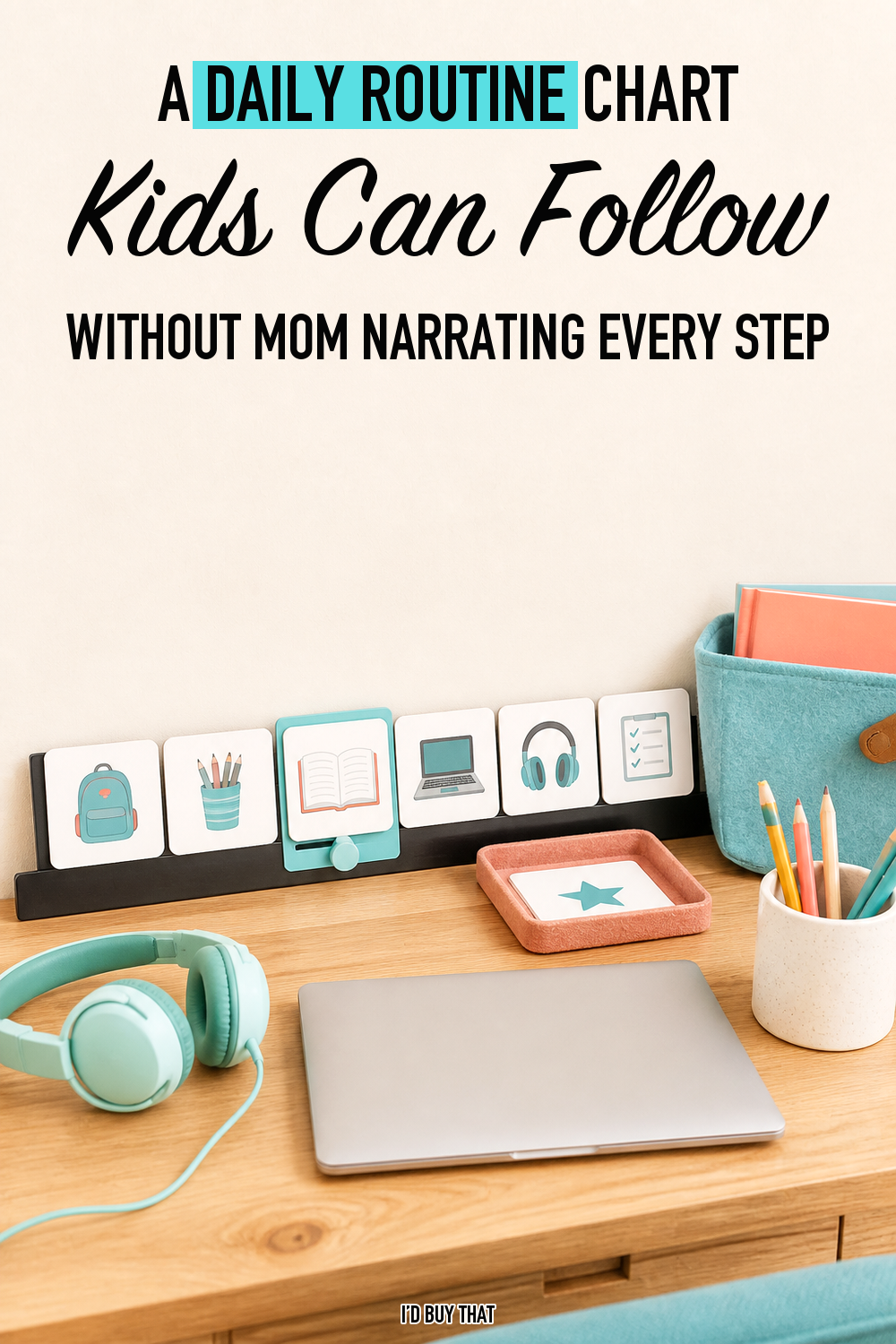
A routine chart is useful only if a child can look at it and know exactly what to do next. “Morning routine” and “schoolwork” are too vague. The adult still has to explain every step.
The example below shows the whole day. Copy it, change the class times, and label each task start alone, with Mom, reset, or close. The goal is simple: the child should not have to ask what happens next every time one task ends.
Copy this board, then change the times
Keep fixed class times, but write every task as a specific action. “Math” is too vague. “Page 4, problems 1–5, then put it in the finished tray” tells the child what to do and what done means. The label tells the child whether to start alone, wait for you, take a break, or pack up.
Teach the three moves the chart cannot teach itself
Practice these when nobody is late. Start: find NOW, collect the materials named on the card, and begin. Stuck: mark the exact problem, stand the HELP card up, and move to the waiting task only if the board says to. Finished: put the work in its named place, move the card to DONE, and uncover NEXT.
Mom’s reset takes three minutes after school closes: copy tomorrow’s fixed times, choose one must-do task per block, put a real break after the hardest block, and set out the first materials. Do not rebuild the morning while everyone is trying to live it.
- Every work card begins with a verb: open, read, solve, put, submit, or charge.
- Every card names what “done” looks like and where the finished thing goes.
- The HELP card has one agreed meaning; it is not a new way to shout across the house.
A chart is not independence. It is a place to practice a few repeatable moves without Mom re-explaining the whole day.
Show only the part of the schedule the child can use
A full schedule may help the adult but overwhelm the child. Keep the full schedule for yourself, then show the child only NOW, NEXT, and BREAK. On a hard day, use the shorter plan shown above instead of trying to make a new schedule in the middle of a difficult morning.
| Who is using it | What stays visible | What the child does |
|---|---|---|
| Early reader | One picture card for NOW and one for NEXT | Hands the finished card to the adult, who reveals the next one |
| Fluent reader | Full day spine plus the three-card work strip | Moves the marker, uses HELP, and completes the close card |
| Two children | One shared spine; one color-coded work strip per child | Checks whether the next task is START ALONE or WITH MOM before interrupting |
The [No-Nag Routine Card Pack](/tools/back-to-school-independence-kit#routine-cards) has the same NOW, NEXT, HELP, DONE, RESET, and REDUCED DAY labels if you do not want to letter them yourself.
If the chart exposes a gear problem
Sometimes the routine is clear but the child still cannot open lunch, keep accepted socks together, carry the backpack comfortably, or return school gear to a reachable home. The [back-to-school problem-solvers guide](/answers/back-to-school-shopping-problem-solvers) shows eight exact products for those specific friction points. Paid links are marked in that guide.
The whole plan
Write the exact task, what done means, and the next break. Teach the child what to do when starting, stuck, and finished.
Save the idea
Save the routine chart.
Open the pin to save the complete daily-routine article for later.